
Breaking Free and Staying Calm is Debra Lindsey’s winning memoir of survival, resilience, and hope. From a childhood wrought by the chaos of war-torn Rhodesia to the trials of starting anew in South Africa, Debra’s drive is an influential tribute to human strength. On her journey, she discovers that the true meaning of joy lies in sharing it, finding happiness in motherhood, and the power of self-belief. Her story shines as an inspiring reminder that even in the gloomiest stretches; we can rise, rebuild, andthrive.
With Breaking Free and Staying Calm, let’s explore how Debra has lost the ability to enjoy life’s simple pleasures due to persistent sadness, family upheaval, life-threatening abuse, and emotional adversity.
Debra Lindsey on Starting Over: Transforming Pain into Strength
This is how you can rise from a crisis through resilience.
Crises are not something we choose to experience; they simply arrive and, often, are unavoidable. The reasons can be many: sometimes they come from a break-up, after the loss of someone we love, from problems at work, or for any other reason that destabilises us.
In Breaking Free, Debra’s crises shake us, overwhelm us, and leave us unsure of what to do. However, even though they hurt, they are not a mistake or a punishment, but rather an opportunity to grow, understand ourselves better, and give our lives a new direction.
In Breaking Free and Staying Calm, we will explore what crises really are with Debra, what role they play in our growth, how we can rebuild ourselves after one, and what strategies can make this path a little clearer and more manageable.
Debra Lindsey’s Insights: What Is a Personal Catastrophe and What Does It Represent?
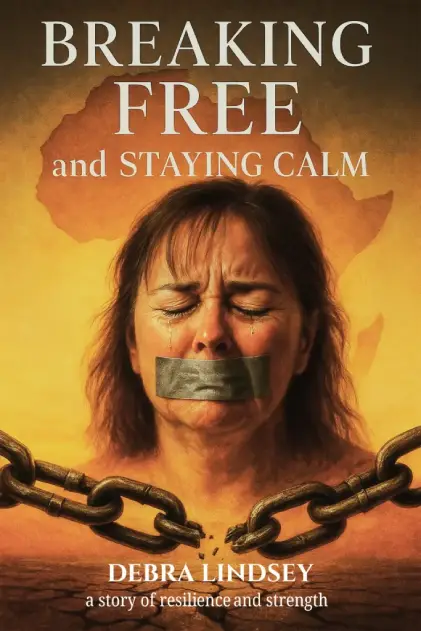
A calamity like the Rhodesian war is not just a bad day or a bad moment. It is a turning point that causes an abrupt disruption of a person’s emotional, mental, or life equilibrium. This, in turn, forces us to reorganise our beliefs, feelings, and life plans. They often appear unexpectedly, as a consequence of a difficult event, although they can also arise from more subtle internal processes, such as an existential or developmental crisis.
This leads us to the different types of calamities: developmental, familial, health-related, economic, social, romantic, or existential. They don’t always occur in isolation. Sometimes, they intertwine or reinforce each other, generating a much deeper impact on the emotional stability of the person experiencing them.
With Breaking Free and Staying Calm, Debra’s approach is not to classify her torments, but to recognize that they are all legitimate and, although painful, have a purpose: they are an invitation to take time to look inward and rethink our lives.
More than a detour, war-scarred disasters serve to clear the path. They are an obligation to focus on what is essential, to prioritise what is important, and to let go of what no longer serves us. Yes, hurt (and that’s normal), but they can become opportunities to redefine personal goals, strengthen identity, and build a new life.
The Emotional Impact
Wars are often accompanied by a general feeling of unease, with varying degrees of intensity depending on the context. So it’s not uncommon to experience symptoms such as anxiety, sadness, irritability, fatigue, confusion, or hopelessness.
In addition, some people may feel alone, disorientated, or disconnected from themselves. These symptoms are not signs of weakness. On the contrary, vulnerability is a human response to a complex situation.
This is where the importance of not minimising the pain lies. You have to let it hurt, because that’s how you’ll understand that all emotions are valid and necessary, that they all have a purpose.
Debra Lindsey’s Keys to Starting Over and Rebuilding
Once you’ve passed through the most intense point, it’s time to rebuild (yourself). This won’t be a linear or immediate process. This will require time, willpower, patience, and above all, self-compassion, self-listening, and self-care. Debra’s Breaking Free strategies for starting over with a fresh perspective after experiencing a crisis:
Accept reality and close the previous chapter.
The first step to starting over is accepting what happened. This means integrating the experience into reality, acknowledging the pain, and allowing yourself to feel. Sometimes, performing a small symbolic ritual, such as writing a farewell letter, can help mark the end of one chapter and open us to a new beginning.
Take care of your emotional and physical health.
It’s necessary to regain inner balance, even if it takes time. This involves establishing or re-establishing healthy routines, such as getting enough sleep, eating properly, and engaging in some physical activity. Practising relaxation techniques can also be helpful, as they help you reconnect with the present and reduce anxiety or stress.
It’s normal to experience ups and downs during this time. In these cases, it’s important to allow yourself to have bad days or days with low energy, without judgement or pressure. It’s all part of the healing process.
Relive what’s important.
By shaking the foundations of life, confrontation offers a unique opportunity to re-evaluate priorities. What things lost value during this process? Which relationships do we want to nurture more? What goals or dreams were put on hold? Asking yourself these kinds of questions helps build a new present and redirect your inner compass towards a new horizon.
Plan with small steps.
Starting over doesn’t mean building a new life overnight, but taking small steps, as Debra does through motherhood. It is enough to begin a process of transformation after experiencing a difficult period to restart and reconnect. Setting realistic, achievable goals allows you to regain a sense of control and move forwards with greater confidence that you can climb out of the hole.
Give yourself a new opportunity.
Starting over is not easy, as we will see in Breaking Free and Staying Calm. No one chooses to suffer or go through periods of chaos. However, when pain arises, there’s nothing left to do but experience it. Adversities, rather than being “dark moments”, can be opportunities for reinvention or transformative experiences in every sense.
Debra Lindsey’s Message in Breaking Free and Staying Calm
Not everything in life is black and white; the experience of living is full of nuances. By this, Debra means that not everything will always be good, but neither will it always be bad. Furthermore, starting over doesn’t mean forgetting everything you’ve experienced; rather, it means honouring it as part of your personal history and using it to build a more conscious, breaking-free, and fulfilled version of yourself.
So now is the time to take the first step toward your own journey of Breaking Free. Remember, your story is still being written—make it one you’re proud of.